How to Build an Opponent Scouting Report Your Staff Will Actually Use
Most scouting reports are too long to read and too vague to coach from. Here is how to build one that fits on a page, answers the questions your coordinators actually ask, and is ready before the Monday staff meeting.
On this page
Key takeaways
- A scouting report exists to change your game plan. If a number will not change a call, cut it.
- Tag every snap the same way first: down, distance, hash, field zone, formation, play type and result.
- Lead with identity (run/pass balance, efficiency, explosives), then formations, then situations.
- Keep the front page to one sheet and link every number back to the clips that prove it.
Every staff has a version of the same Sunday: two or three games of opponent film, a spreadsheet that started clean in August, and a report that is finished just in time for nobody to read it closely. The problem is rarely effort. It is that the report tries to describe everything instead of answering the handful of questions that decide a game plan.
This guide walks through a format that works for high school football staffs: what to tag, what to calculate, and how to lay out a report that your coordinators can coach from on Monday. The same structure works whether you build it by hand or let Agent X build it from your tagged film.
Start with the questions, not the film
Before anyone presses play, write down what the staff needs to know by Monday. For most weeks the list is short:
- Who are they? Are they a run team, a pass team or balanced, and how efficient are they at it?
- How do they line up? Their most-used formations and what each one tends to mean.
- What do they do when it matters? Third down, red zone, backed up, and two-minute.
- Where can we hurt them? The situations where they stall, turn it over or give up explosives.
Every section of the report should answer one of those questions. If a chart does not, it goes in the appendix or it goes away.
Step 1: Tag every snap the same way
Tendencies are only as good as the tags underneath them. Agree on one set of columns for the season and tag every snap, including penalties and kicks, so your totals add up. A practical baseline:
| Column | Example values | Why it matters |
|---|---|---|
| Down and distance | 1st & 10, 3rd & 4 | Situational tendencies |
| Hash | L, M, R | Formation and run-direction tells |
| Yard line / field zone | -40, +15, red zone | Play calling changes by field position |
| Offensive formation | Trips right, Pro I, Empty | The core of the report |
| Play type | Run, pass, RPO, screen | Run/pass balance by situation |
| Result | Gain/loss, TD, INT, penalty | Efficiency and explosives |
Step 2: Define their offensive identity
The first block of the report should tell a coordinator who this team is in four or five lines. These numbers come straight from the tags:
- Run/pass balance: total runs versus passes, and the split on early downs.
- Yards per play: total yards divided by snaps, so one long run does not hide a struggling offense.
- Efficiency: the share of plays that stay on schedule (a common rule: 40% of the yards needed on 1st down, 60% on 2nd, 100% on 3rd and 4th).
- Explosive plays: runs of 10+ and passes of 15+ yards, and the negative plays they give back.
Step 3: Break down formations and what they tell you
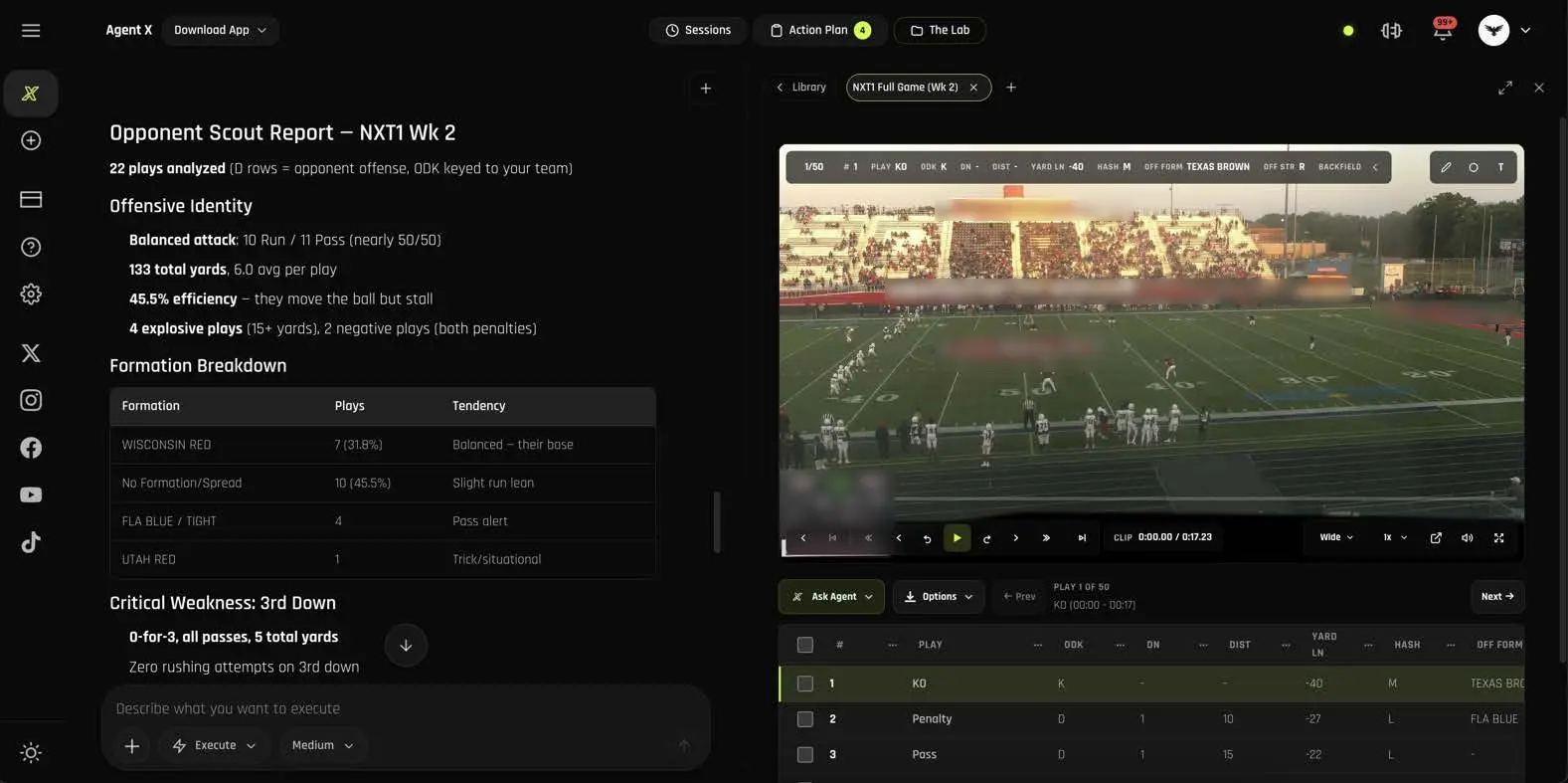
List their formations from most to least used, with the number of snaps, the run/pass split and a one-word tendency. Coaches scan this table more than anything else in the report, so keep it tight: five or six rows covers most opponents, and anything used once or twice gets grouped as “other.”
The tendency column is where the report earns its keep. “Balanced — their base,” “slight run lean,” or “pass alert” is something a linebacker coach can teach on Tuesday. A percentage alone is not.
Step 4: Find the situations that decide games
Most games turn on a few situations. Break the tags out by third down (short, medium, long), red zone, backed up inside their own 10, and two-minute. For each, note what they call and how well it works.
This is usually where the “critical weakness” shows up. A team that is 0-for-3 on third down, throws on every one of them and has not run the ball on third down all game is telling you exactly what to play.
Step 5: Put it on one page, and link the proof
The front page is for the meeting. It should hold the identity block, the formation table, the situational notes and three to five bullet points on how to attack. Everything else (personnel notes, the full play list, special teams) goes behind it.
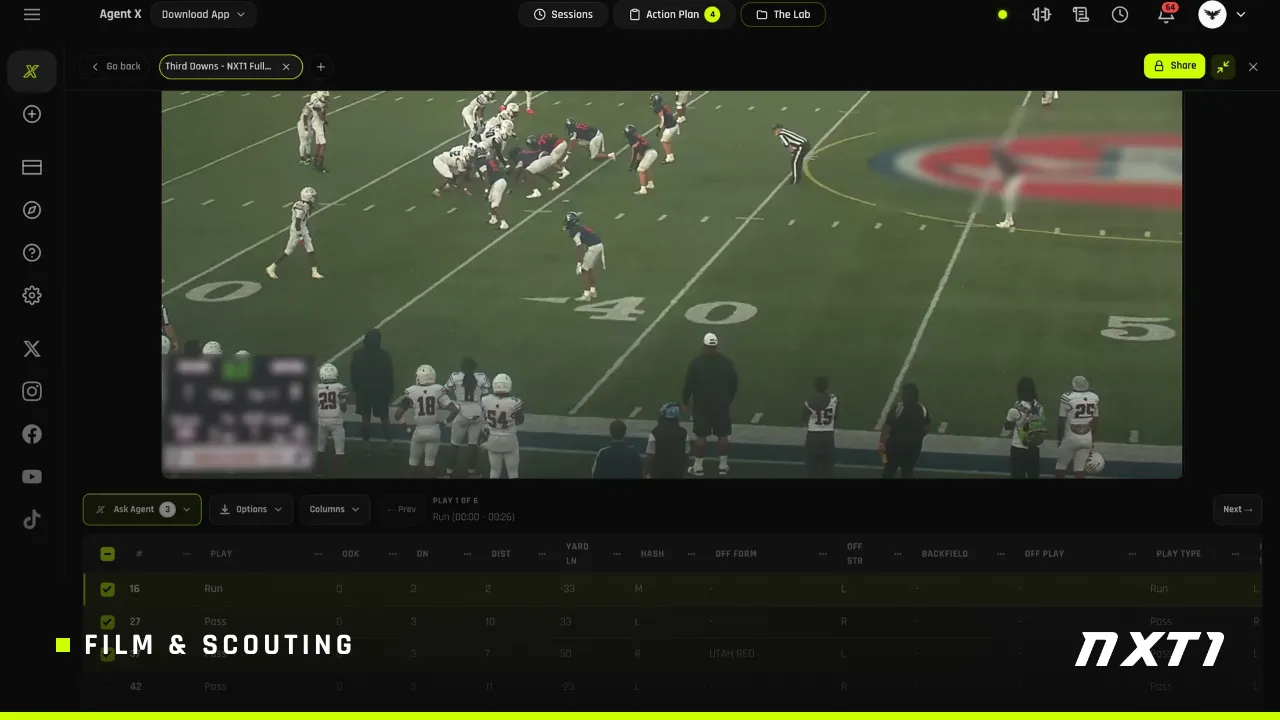
The best reports let any coach click a number and see the plays behind it. When every stat links back to the clips, nobody argues about whether a tendency is real; they watch it.
If a number in the report will not change a call, a rep in practice or a coaching point, it does not belong on the front page.
How Agent X builds the same report
Agent X follows the same structure. It tags every snap by formation, down, distance and hash, then builds an Opponent Scout Report with offensive identity, formation tendencies and critical weaknesses such as third-down performance. Every number links back to the clip, and the report lands in The Lab with your film, cutups and call sheets.
Football staffs can also have Agent X produce the self-scout, practice scripts and printable call sheets, wristbands and scout team cards from the same tags. See what that looks like on the football page, or read our guide to self-scouting your own tendencies.
Frequently asked questions
How many games of film do you need for an opponent scouting report?
Two or three recent games is the usual target. One game gives you a picture of identity; two or three give you enough snaps per formation and situation to trust a tendency. Weight the most recent games more heavily.
What should be on the first page of a scouting report?
Offensive identity (run/pass balance, yards per play, efficiency, explosive plays), a formation table with snap counts and tendencies, the key situations (third down, red zone) and three to five bullet points on how to attack them.
How long does it take to build a scouting report?
By hand, tagging and charting two or three games typically takes a staff most of a weekend. With Agent X, the tagging and the report are built from the film, so the staff spends its time reviewing and deciding instead of charting.
The NXT1 Blog
Get new playbooks in your inbox
Film, scouting and program playbooks for coaches and athletic directors.